FREE AUDIO: al-Istiqaamah (Steadfastness) Seminar

This post contains the of free lectures from the al-Istiqaamah (Steadfastness) Seminar that took place in Detroit, MI this past April 2013.

Our noble brother Abu Muhammad a-Maghribi covered the books:

‘Ashru Qawaa’id fil-Istiqaamah (10 Principles of Steadfastness) by Shaykh Abdur-Razzaaq Al-Badr – 6 MP3 Set

ashara_qowaid_fil_istiqomah

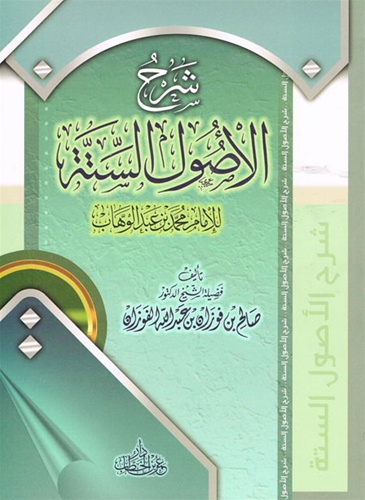
Sharh al-Usool us-Sittah (Explanation of the 6 Principles) by Shaykh Saalih Ibn Fawzaan al-Fawzaan – 4 MP3 Set

AQ0190S-2

Additional talks at the al-Istiqaamah Seminar were also delivered and are all available to  download for free below.

Talkin’ it Out with the Youth

Sisters al-Istiqaamah Class

Sisters Q & A Session

Shaykh Musayd al-Husayni tele-link

Jum’ah Khutbah


AUDIO: ‘Aqidah of al-Raziyayn by Shaykh Khaalid Ibn Dahwee adh-Dhufayree – Lesson 1

aqidahraziyayh

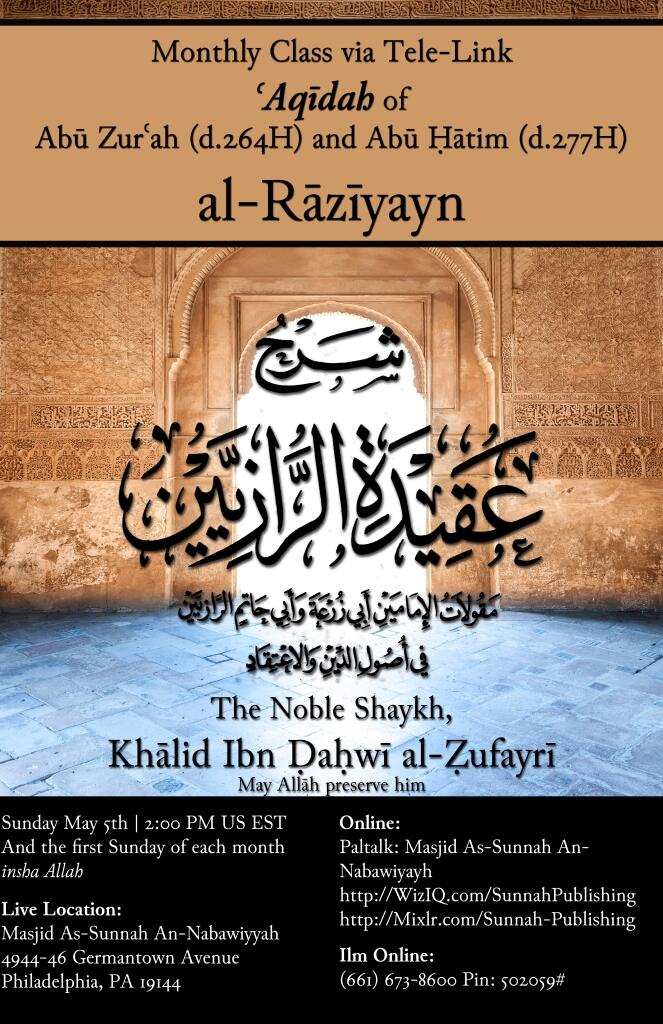
Monthly Class covering the book

‘Aqidah

 of Abu Zurah (d.264H) and Abu Hatim(d.277H)

al-Raziyayn

Explained by

The Noble Shaykh

Khalid Ibn Dahwi al-Zufayri

May Allaah preserve him


Sunday May 5th @ 2:00 PM US EST

And the First Sunday of each Month inshaa’ Allaah


Live Location:

Masjid as-Sunnah an-Nabawiyyah

4944-46 Germantown Ave

Philadelphia, PA 19144


Online:

http://sunnahpublishing.net/live/

WizIQ.com/SunnahPublishing.net

Mixlr.com/Sunnah-Publishing

Paltalk: Masjid as-Sunnah an-Nabawiyyah


Ilm Online:

(661) 673-8600

Pin: 502059#


Lesson 1 – May 5, 2013

[wpdm_package id=62]


Lesson 2 – June 2, 2013


Lesson 3 – July 7, 2013


Lesson 4 – August 4, 2013


Lesson 5 – September 1, 2013


Lesson 6 – October 6, 2013


Lesson 7 – November 3, 2013


Lesson 8 – December 1, 2013


Lesson 9 – January 5, 2014


Lesson 10 – Feburary 2, 2014


Lesson 11 – March 2, 2014


Lesson 12 – April 6, 2014


Lesson 13 – May 4, 2014

Shaykh Saalih Ibn Fawzaan al-Fawzaan Praises Shaykh Rabee’ Ibn Haadee al-Madkhalee

[fap_track id=”3368″ layout=”list” enqueue=”no” button_enqueue=”no”]

[Q]: There has emerged in the arena a book entitled, Adwaa‘ Islaamiyyah ’alaa ’Aqeedah Sayyid Qutb wa Fikrihi (Islaamic Illuminations upon the Creed and Ideology of Sayyid Qutb), written by its author, Rabee’ al-Madkhalee.  What is your view concerning this book and is the author from the people of knowledge who are known to you?

[A]: There is no doubt that the author is from the people of knowledge and a graduate of the Islaamic University and he was a student of the Scholars and he is well-known, and the praise is for Allaah.  And you can look up whatever he has mentioned from errors, he has mentioned the pages.  Look them up in Dhilaalul-Qur‘aan.  So if you find that he was mistaken, then clarify his mistake, and if not, then it is obligatory to accept the truth.  The obligation is to accept the truth.  He mentioned the errors found in that book, along with their pages, he numbered them for you.  You can refer back to them and look up the speech.  So if you find a mistake, then notify the author about it – may Allaah reward you.  And if you find the correct view, then it is obligatory upon you to accept the correct view.

Likewise, the Noble Shaykh – hafidhahullaah – was asked, “Indeed, in these days a book has come out entitled, Adwaa‘ Islaamiyyah ’alaa ’Aqeedah Sayyid Qutb wa Fikrihi (Islaamic Illuminations upon the Creed and Ideology of Sayyid Qutb).  And the author concludes that Sayyid Qutb (k.1966H) fell into significant errors in ’aqeedah (creed).  We hope – O Noble Shaykh – that you will inform us about your view concerning this book.”

So al-’Allaamah Saalih Ibn Fawzaan al-Fawzaan replied, “This is a fine deed and its doer is a doer of good, because he did not come with anything from himself.  And he did not fabricate lies upon Sayyid Qutb, he only mentioned actual errors in his books.  And he made note of them by mentioning the pages and quoting the speech.  And as long as he does that, then there is no blame upon him.  As long as he mentions the error and supports his statement with evidence and he documents that from the man’s own book, then he has fulfilled what was upon him.  And everyone errs, Sayyid Qutb errs and others err.  And the praise is for Allaah that the truth is the objective of the Believer.  As long as the author does not come with something from himself, and he does not spread rumours about the man, and he does not lie upon the man, and he only quotes the man’s speech from his own books and he mentions the pages of the book, then he is free from rebuke.  And this type of clarification is necessary because these books are in the hands of the youth and their author is considered to be from the leaders of the ideology.” [1]

Endnotes:
[1]: Refer to Maa Yajib fit-Ta’aamul ma’al-’Ulamaa‘ (p. 32-33) of al-Furaydaan. BENEFIT – al-’Allaamah Saalih al-Fawzaan is from the Imaams of Islaam: al-’Allaamah Rabee’ Ibn Haadee al-Madkhalee said, “So this was Maalik (d.179H), with whom ash-Shaafi’ee (d.204H) and al-Layth (d.175H) disputed in several issues, yet according to us he is from the prodigious Imaams of the Sunnah.  And this ash-Shaafi’ee opposed Imaam Ahmad in several issues where the correct view was with Imaam Ahmad, and Ahmad has views that are less preponderant than others, yet according to us he is the Imaam of Ahlus-Sunnah after him (i.e. ash-Shaafi’ee) and up until today.
And Ibn Taymiyyah (d.728H) and Ibnul-Qayyim (d.751H) and Ibn ’Abdul—Wahhaab (d.1206H) and Ibn Baaz (d.1420H) and al-Albaanee (d.1420H) have issues in which we oppose them, and Ibnul-’Uthaymeen (d.1421H) and al-Fawzaan, yet they are Imaams of Islaam according to us.”  Refer to Majmoo’ Kutub wa Rasaa‘il wa Fataawaa (10/277) of Rabee’ al-Madkhalee.

Translation by Maaz Qureshi

Special Characteristics of the Salafee Woman

Imaam Muqbil Ibn Haadee al-Waadi’ee (d.1421H)


[1]: She holds fast to the Book of Allaah and the Sunnah of the Messenger of Allaah (sallallaahu ’alayhi wa sallam), within the limits of her capability, upon the understanding of the Salafus-Saalih.

[2]: And it is also befitting for her to deal with the Muslims in a fine manner.  Rather, even with the disbelievers.  So Allaah the Mighty and Majestic says in his Noble Book,

And speak to people good words…” [Sooratul-Baqarah  2:83]

And He says,

Indeed, Allaah commands you to render trusts to whom they are due.” [Sooratun-Nisaa‘ 4:5]

And He also says,

And when you testify, then be just.” [Sooratul-An’aam 6:152]

And Allaah the Glorified and Exalted said,

O you who have believed, be persistently standing firm in justice, witnesses for Allaah, even if it be against yourselves or parents and relatives. Whether one is rich or poor, Allaah is more worthy of both. So follow not personal inclination, lest you not be just. And if you distort your testimony or refuse to give it, then indeed Allaah is ever, with what you do, Acquainted.” [Sooratun-Nisaa‘ 4:135]

[3]: Likewise, it is obligatory upon her to maintain the Islaamic dress.  And she must distance herself from the enemies of Islaam.  Imaam Ahmad (d.241H) relates in his Musnad from the hadeeth of ’Abdullaah Ibn ’Umar (radiyallaahu ’anhumaa) who said, ‘The Messenger of Allaah (sallallaahu ’alayhi wa sallam) said, ‘Whosoever resembles a people, then he is from them.” [1]

And Allaah, the Lord of Might, says concerning the affair of the dress,

O Prophet, tell your wives and your daughters and the women of the believers to bring down over themselves part of their outer garments. That is more suitable that they will be known and not be abused.” [Sooratul-Ahzaab 33:59]

And at-Tirmidhee (d.274H) relates in his Jaami’ from the hadeeth of ’Abdullaah Ibn Mas’ood (radiyallaahu ’anhu) who said, ‘The Messenger of Allaah (sallallaahu ’alayhi wa sallam) said, ‘The woman in an ’awrah (whatever is required to be covered).  So when she goes out, the Shaytaan looks out for her.” [2]

[4]: And we advise her to treat her husband well if she desires a felicitous life.  So the Prophet (sallallaahu ’alayhi wa sallam) said, “When a man calls his wife to his bed and she refuses, the Angels curse her.” [3] The hadeeth is agreed upon.  And there occurs in Saheeh Muslim, “…except that the One who is above the heavens is angry with her.” [4]

[5]: Likewise, she must also carry out the upbringing of her children with an Islaamic upbringing.  So al-Bukhaaree (d.256H) and Muslim (d.261H) relate in their Saheehs from the hadeeth of ’Abdullaah Ibn ’Umar (radiyallaahu ’anhumaa) who said, ‘The Messenger of Allaah (sallallaahu ’alayhi wa sallam) said, ‘Each of you is a shepherd and each of you will be questioned about his herd.” [5] And he mentioned that the woman is, “a guardian over the household of her husband and she will be questioned about her flock.” [6]

And there occurs in the Saheehayn (i.e. al-Bukhaaree and Muslim) from the hadeeth of Ma’qil Ibn Yasaar (radiyallaahu ’anhu) who said, ‘The Messenger of Allaah (sallallaahu ’alayhi wa sallam) said, ‘There is no shepherd whom Allaah has entrusted with a flock and then he does not sincerely render his trust, except that he will not find the fragrance of Paradise.” [7] So it is not permissible to pre-occupy her with the da’wah over the upbringing of her children.

[6]: Likewise, it is befitting for her to be pleased with whatever Allaah has judged from the excellence of the man over the woman.  Allaah the Glorified and Exalted said,

And do not wish for that by which Allaah has made some of you exceed others.” [Sooratun-Nisaa‘ 4:32]

And Allaah the Glorified and Exalted says,

Men are in charge of women by right of what Allaah has given one over the other and what they spend for maintenance from their wealth. So righteous women are devoutly obedient, guarding in the husband’s absence what Allaah would have them guard. But those wives from whom you fear arrogance – first advise them; then if they persist, forsake them in bed; and finally, strike them. But if they obey you once more, seek no means against them.” [Sooratun-Nisaa‘ 4:34]

And there occurs in the Saheehayn from the hadeeth of Abee Hurayrah (radiyallaahu ’anhu) who said, ‘The Messenger of Allaah (sallallaahu ’alayhi wa sallam) said, ‘Treat women kindly, for woman was created from a bent rib, and the most crooked part of the rib is the top part.  So if you should try to straighten it, it will break, but if you leave it as it is, it will remain crooked.” [8] So it is befitting for the woman that she remain patient upon whatever Allaah has decreed for her in terms of the man’s excellence over her.  And this does not mean that she must be enslaved to him.  The Messenger of Allaah (sallallaahu ’alayhi wa sallam) said, as occurs in the Jaami’ of at-Tirmidhee, “Treat the women kindly, since they are only wards amongst you.  They do not have anything else over you.  Indeed, you wives have a right over you.  Indeed, you have a right over them.  So your right over them is that they do not allow those whom you detest to trample your bed and that they do not allow into your household those whom you detest.  And your right over them is that you treat them kindly with regards to their food and their clothing.” [9] And their occurs in the Sunan and in the Musnad of Imaam Ahmad (d.241H) from the hadeeth of Mu’aawiyah Ibn Haydah, that a man said, “O Messenger of Allaah!  What is the right that our wives have over us?”  He replied, “That you feed them whenever you eat and that you clothe them with whatever clothes you have an do not strike them in the face and that you do not rebuke them and that you do not separate from them, except within the house.” [10]

So what was it, may Allaah bless you?  So it is befitting that all of us co-operate upon goodness.  The man must deal with his wife in an Islaamic manner and he must aid her in seeking knowledge and he must aid her in calling to Allaah.  And the woman must deal with her husband in an Islaamic manner and she must aid him in knowledge and in calling to Allaah and in good upkeep of the household.  So Allaah the Mighty and Majestic says,

And co-operate upon righteousness and piety and do no co-operate upon sin and transgression.” [Sooratul-Maa‘idah 5:2]

And Allaah is the One from whom aid is sought. [11]

Endnotes:
[1]: Saheeh: Related by Aboo Daawood (no. 4031), Ahmad in al-Musnad (no. 5093).  It was authenticated by al-Albaanee in Ghaayatul-Maraam (no. 109).
[2]: Saheeh: Related by at-Tirmidhee (no. 1173).  It was authenticated by al-Albaanee in Saheehut-Tirmidhee (no. 936).
[3]: Related by al-Bukhaaree (no. 4897), Muslim (no. 2596), Aboo Daawood (no. 2141) and Ahmad in al-Musnad (no. 9379)
[4]: Related by Muslim (no. 2595).
[5]: Related by al-Bukhaaree (no. 853), Muslim (no. 1829), Aboo Daawood (no. 2928), at-Tirmidhee (no. 1705) and Ahmad in al-Musnad (no. 5145).
[6]: Related by al-Bukharee (no. 2419) Muslim (no. 3408) and Ahmad in al-Musnad (no. 5990).
[7]: Related by al-Bukhaaree (no. 6646), Muslim (no. 142) and ad-Daarimee in his Sunan (no. 2796).
[8]: Related by al-Bukhaaree (no. 4890) and Muslim (no. 1468).
[9]: Hasan: Related by Ibn Maajah (no. 1851) and at-Tirmidhee (no. 1163).  It was authenticated by al-Albaanee in Saheehut-Tirmidhee (no. 929).
[10]: Saheeh: Related by Aboo Daawood (no. 2142) and Ahmad in al-Musnad (no. 19509).  It was authenticated by al-Albaanee in Ghaayatul-Maraam (no. 244).
[11]: Taken from Majmoo’ul-Fataawaa an-Nisaa‘iyyah of Muqbil Ibn Haadee.

Translation by Maaz Qureshi
Shaykh ’Ubayd Ibn ’Abdullaah al-Jaabiree on the Allegation that al-Jarh wat-Ta’deel Divides the Muslims in the West


[Q]: The questioner says: It has been spread that the fitnah (trial, tribulation) of al-Jarh wat-Ta’deel splits up the Ummah and speaking out against the people of innovation causes separation within the Ummah, especially those living in the western countries.  So they split up and distort the representation of Islaam by way of their speech against the mashaayikh, ‘This one is a hizbee (biased partisan),’ and the likes of that.

[A]: O my son, the Shaytaan has caused this rumour to circulate upon everyone’s tongues against Ahlus-Sunnah wal-Hadeeth.  The theme of the gathering is clear, so why do you beat about the bush and wander around by mentioning these ambiguities?!  Allaah the Glorified and Exalted has refused, except to separate between the truth and the falsehood and the guidance and the misguidance.  So why do you generalize?

Have you not come across the hadeeth, which mentions the procession of nations (umam)?  It occurs in the Saheehayn (i.e. the hadeeth collections of al-Bukhaaree and Muslim).  The Prophet (sallallaahu ’alayhi wa sallam) said, “I saw a Prophet passing and he had with him a raht – it is said this is a group of three to ten people – and a Prophet would pass and he would have with him three followers, and another would have two.  And a Prophet would pass and he would only have one man with him.  And a Prophet would pass and he would not have anyone with him.” [1] This Prophet who will have no one with him, was he sent to himself only?  Of course not!  He was sent to a nation (ummah).  However, that nation rejected his call.  And Ahlus-Sunnah never gossip about anyone, ever.  They only refute the innovation with evidence.  And consideration is not given to a large following, consideration is given to obtaining the truth.

The Shaykh, Muhammad Ibn ’Abdul-Wahhaab (d.1206H) – rahimahullaah – the Imaam of the da’wah and the reviver in the middle of the twelfth Hijree generation, the one who was aided by his brother, al-Ameer Muhammad Ibn Sa’ood – rahimahullaahul-jamee’ – derived rulings from this hadeeth, from them: that it is not permissible to forsake a small following, nor is it permissible to have high regard for a large following. [2]

And this is in agreement with a beautiful statement from al-Fudayl Ibn ’Iyaad (d.187H) – rahimahullaah – who said, “Hold fast to the paths of guidance and the scarcity of followers will not harm you.  And beware of the paths of misguidance and do not be deceived by the large numbers of those who are destroyed.” [3] So the majority have never been mentioned in a praiseworthy manner, ever. [4] We would love that the heads of disbelieving nations accept Islaam and remain upon the Sunnah: the president of America, the president of Russia, the king of Holland, the president of Poland and other than them.  We would love that they accept Islaam and remain upon the Sunnah, we do not dislike Islaam and the Sunnah for anyone and we invite them with wisdom and a beautiful admonition.

Endnotes:
[1]: Related by al-Bukhaaree (no. 5420), Muslim (no. 323) and Ahmad in al-Musnad (no. 2444).
[2]: Shaykhul-Islaam Muhammad Ibn ’Abdul-Wahhaab (d.1206H) – rahimahullaah – said, “The fruit of this knowledge is to not have a high regard for a large following and to not forsake and be disheartened by a small following.”  Refer to Fathul-Majeed (p. 90), with the comments of Imaam Ibn Baaz and the checking of Shaykh Muhammad Haamid al-Fiqee.
[3]: Refer to al-I’tisaam (1/135) of ash-Shaatibee.  Sufyaan Ibn ’Uyaynah (d.197H) – rahimahullaah – said, “Traverse the path of truth and do not feel lonely due to the few people upon it.”  Related by Ibn ’Abdul-Barr in at-Tamheed (17/429).
[4]: BENEFIT – Imaam Muhammad Naasirud-Deen al-Albaanee on the Scarcity of Those who Answer the Da’wah: The Messenger of Allaah (sallallaahu ’alayhi wa sallam) said, “No Prophet from amongst the Prophets will have as many followers as me. Indeed, there will be from amongst the Prophets he who had no one believing in him, except one man.”  Related by Muslim (1/130).
Imaam Muhammad Naasirud-Deen al-Albaanee (d.1420H) commented upon this hadeeth, saying, “In this hadeeth is a clear proof that the abundance of followers, or lack thereof is not the measuring standard that indicates whether the caller is upon truth or falsehood. So even though the da’wah of these Prophets – ’alayhimus-salaatu was-salaam – was one and their Religion was one, their varied with regards to the numbers of their followers. Some of them had many and some of them had a few, to the extent that some had no one to believe in them except one man. Rather, there was from amongst them he who had not a single follower!
So in this is a profound lesson for the callers and those who are being called in this age of ours. So it is obligatory upon the caller to remember this reality. He must remain for a long time in the path of calling to Allaah the Exalted, and he must not pay any attention to the scarcity of those who answer him, because there is nothing upon him, except to convey the message clearly. And he has the best example in the previous Prophets who did not have anyone with them other than one or two men!
So the one being called upon must not despair due to the scarcity of those who answer the caller, and he must not take that as a reason for doubting in the da’wah of truth and thus abandon eemaan (faith) in it, let alone that he would take that as an indication of the falsity of the da’wah with the argument that no one is following this caller, or that only a few are following him. And if his da’wah were truthful, the majority of the people would not follow him! Allaah the Mighty and Majestic said,
And most of mankind will not believe, even if you desire it eagerly.” [Soorah Yoosuf 12:103].”
Refer to Silsilatul-Ahaadeethis-Saheehah (no. 397) of al-Albaanee.

Translation by Maaz Qureshi